
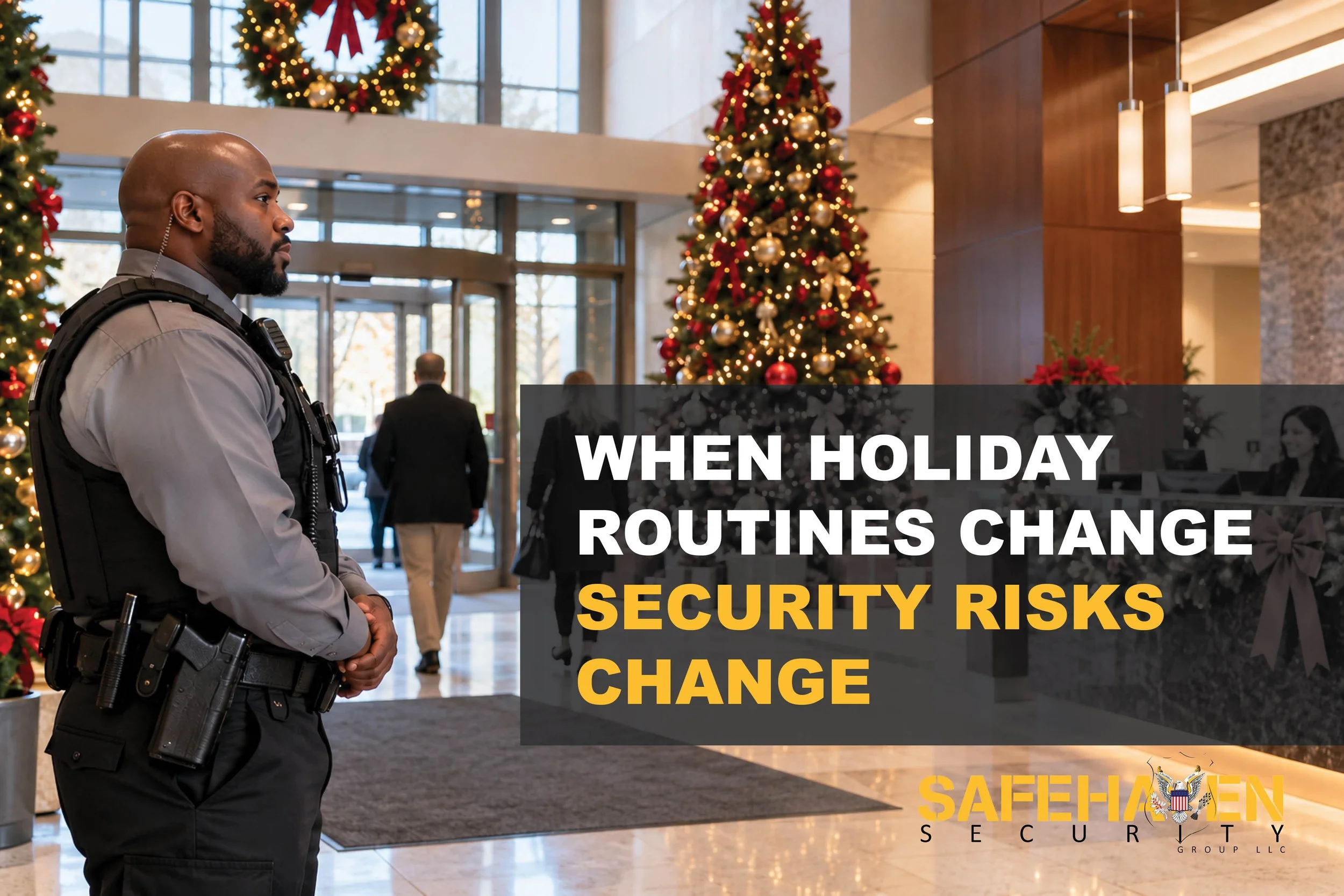
For most organizations, the holiday season changes the normal operating environment.
Employees take vacation. Offices operate with reduced staffing. Facilities may open or close at different times. Deliveries increase. Temporary employees, contractors, vendors, customers, and visitors may come and go more frequently. Holiday parties and other events bring people into facilities who may not normally be there.
Yet many organizations make all of these operational changes without making any changes to their security posture.
That can create vulnerabilities.
Security should never be based simply on what an organization does during a normal week. It should be based on the risks that exist today. When operating conditions change, security needs to change with them.
More Activity Creates More Opportunity for Security Gaps
During the holidays, employees become accustomed to seeing unfamiliar faces.
There may be seasonal employees working in a facility. Delivery drivers are arriving throughout the day. Vendors and contractors may be completing year-end work. Family members or guests may visit the workplace. Holiday events may bring dozens or even hundreds of additional people onto a property.
In that environment, it becomes much more difficult for employees to determine who belongs and who does not.
A trained Security Officer provides another layer of awareness. Officers can monitor entrances, verify visitors, patrol areas of concern, recognize unusual behavior, and address problems before they escalate.
That presence becomes particularly important when the rest of the organization is distracted or operating outside its normal routine.
Reduced Staffing Changes the Risk
The holidays can also create the opposite problem: fewer people.
Departments may operate with skeleton crews. Managers may be out of the office. Employees who normally work with a large team may suddenly find themselves working nearly alone.
Those conditions matter.
An employee walking to a parking lot after dark with only a handful of people remaining in the building faces a different environment than that same employee leaving with hundreds of coworkers at 5:00 p.m.
Good security programs recognize the differences.
Organizations should evaluate whether changes in staffing, operating hours, access points, parking patterns, and facility occupancy require temporary changes in officer coverage or patrol frequency.
Holiday Security Is About More Than Theft
When people think about holiday security, theft is often the first concern that comes to mind.
It is certainly part of the equation.
Businesses may have additional inventory, equipment, packages, or merchandise on-site. Buildings may sit vacant for extended periods. Parking lots and garages are darker earlier in the day. Reduced staffing can also make unauthorized activity less noticeable.
But physical security involves more than protecting property.
A Security Officer’s most important role is to protect people.
The holiday season can bring additional stress into the workplace. Employees may be dealing with financial pressure, family conflict, relationship problems, year-end performance issues, layoffs, terminations, or other personal and professional challenges.
Threats, intimidation, stalking, escalating conflict, domestic violence concerns, or significant changes in behavior should be taken seriously regardless of the time of year.
Employees should know how to report concerns. HR and leadership should know who to contact when a situation requires additional assessment. And when appropriate, an increased on-site security presence can provide both deterrence and immediate response capability.
Visibility Matters
There is significant value in simply having a trained professional visibly present.
A uniformed Security Officer sends a message that access is controlled, the property is being monitored, and someone is paying attention.
But visibility is only part of the officer's job.
Professional Security Officers are trained observers. They recognize behavior that appears out of place. They de-escalate conflicts and provide an immediate resource when an employee or visitor needs assistance.
The best security work often happens before anyone realizes there was a problem.
A door is secured before someone gains unauthorized access.
A suspicious person is approached before entering a restricted area.
An escalating disagreement is addressed before it becomes a physical confrontation.
An employee is safely escorted to a vehicle.
A potential vulnerability is identified and corrected before someone takes advantage of it.
That is prevention.
Don't Simply Add Security—Evaluate the Risk
Increasing security during the holidays does not necessarily mean every organization needs to put an officer at every door.
It means leadership should stop and evaluate what has changed.
Ask:
Are our operating hours different during the holiday season?
Will we have fewer employees on-site?
Will employees be arriving or leaving when the property is relatively empty?
Are visitor, vendor, or delivery volumes increasing?
Are we bringing in temporary employees or contractors?
Are we hosting holiday parties or other large events?
Will portions of our facility be vacant for extended periods?
Do we have valuable equipment, inventory, or property that requires additional protection?
Are there existing employee or behavioral concerns that require additional attention?
Should we adjust Security Officer coverage, patrol frequency, or access-control procedures?
Security should match the environment.
If the environment changes, the security plan should change too.
Prevention Is the Goal
One of the biggest misconceptions about security is that its value is measured by how officers respond when something bad happens.
Response matters.
Prevention matters more.
The objective of professional security is not to make employees afraid or turn a workplace into a fortress. It is to create an environment where people can work, customers can conduct business, and organizations can continue operating because risks are being actively managed.
The holiday season creates changes in routines, staffing, traffic, and behavior. Those changes deserve attention.
Before the holidays arrive, organizations should review their security posture, identify where their risk has changed, and determine whether their existing security measures are still appropriate.
Because the best time to identify a security gap is before someone else finds it.